

How animal science can support the role of animals in delivering benefits to society [Report]
On March 29 2023, Bertrand Dumont, Agroecology-TRANSECT coordinator, delivered a talk entitled 'How animal science can support the role of animals in delivering benefits to society' at the annual meeting of the British Society of Animal Science. He analysed how contrasting options for sustainable animal production and feed-use deliver a number of benefits to society, and on cropland production, by providing manure.
He discussed three agroecological options and compared them with sustainable intensification - an efficiency-oriented framework that aims to increase the productivity of agricultural land to limit further loss of undisturbed ecosystems.
On the other side of the productivity gradient, agricultural re-wilding aims to restore biodiversity and ecological processes, with animal production as a co-benefit.
The three agroecological options aim to reduce reliance on chemical inputs and to limit feed-food competition.
These are:
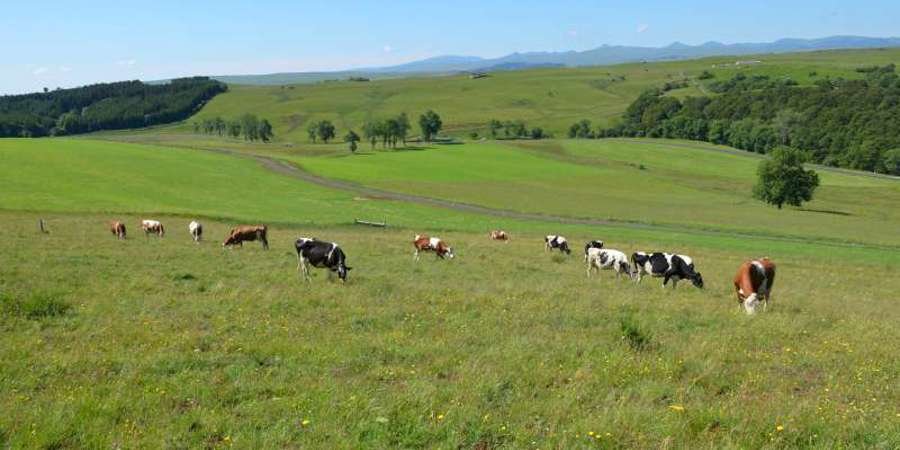
1) Feeding herbivores a grass-based diets, and monogastric animals on industry/cropland by-products and food-waste resources, puts value on non-edible resources while at the same time providing animal protein to humans. The permanent grasslands central to the herbivore diet provide attractive landscapes that benefit recreational pursuits, such as hiking and enjoying nature.
2) The priority for livestock to provide services to cropping leads to a reduction in livestock numbers. Herbivores graze cover crops and monogastric animals produce animal manure that can be used to replace synthetic fertilisers. Animal housing are adapted to collective management of manure (e.g. methanisation), whose composition (e.g. nitrogen content) is of key importance.
3) Human food production becomes marginal when rare or local breeds or animal production systems are used primarily for biodiversity conservation. This is permitted by European agriculture subsidies that allow these systems to be maintained, for instance, in upland and Mediterranean areas. Predation by wild carnivores becomes a key issue.
This analysis opens a challenging research agenda for the animal science community
Three key research issues are:
i) How to select animals adapted to fluctuating feed availability and quality, also limiting methane emissions through the selection of traits such as residual feed intake.
ii) How to feed animals with resources (e.g. tannin-rich plants) that allow shifting the N partition from urinary towards fecal N to reduce nitrous oxide emissions that have a high warming potential.
iii) How to quantify the consequences of these options (and their combinations) on food production, biodiversity, greenhouse gas emissions per ha and per unit of product, and on carbon (C) sequestration in agro-ecosystems.
Find out more:
Make ruminants green again – how can sustainable intensification and agroecology converge for a better future? Animal, Vol 12, 2018
https://doi.org/10.1017/S1751731118001350
Beyond agroecology: Agricultural rewilding, a prospect for livestock systems,
Agricultural Systems, Vol 199, 2022
https://doi.org/10.1016/j.agsy.2022.103410
Opinion paper: Livestock is at the heart of interacting levers to reduce feed-food competition in agroecological food systems, Animal, Vol 16, 2022
https://doi.org/10.1016/j.animal.2021.100436
Forty research issues for the redesign of animal production systems in the 21st century,
Animal, Vol 8, 2014
Keywords: Biodiversity, Livestock, Local food systems, Low input farming, Organic Agriculture, Policy, Transdisciplinary research
Country: EU, Pan-Europe, Global
