


Toolkit / Resources
Search through useful resource resources from Agroecology-TRANSECT.

Search Toolkit
Useful keyword search terms:
Access to land, Arable, Biodiversity, Certification, Citizen science, Climate change, Conservation agriculture, Cover crops, Horticulture, Livestock, Local food systems, Low input farming, Organic Agriculture, Policy, Policy brief, Reduced tillage, Socio economic resilience, Stripcropping, Transdisciplinary research
Useful country search terms:
Belgium, Bulgaria, Denmark, France, France (Guadeloupe), Germany, Hungary, Netherlands, Romania, Spain, Slovenia, Switzerland, EU, Other, Global, Pan-Europe
Search by Resource Type/Audience

Browse Toolkit/Resources
![Policy brief: Towards stronger agroecology in Europe [read the full report]](https://images.squarespace-cdn.com/content/v1/6a2686979288c1416040814a/1785848269690-JH7564AO07Y8ZPDZOFJD/resources-policy+brief-towards+stronger+ag+in+europe.jpg)
Policy brief: Towards stronger agroecology in Europe [read the full report]
The project has explored the co-creation of knowledge to support agroecological transitions and, by engaging directly with on-the-ground actors, has gathered key insights about agroecological transformations.
![Policy brief: EU agri-food policies need better indicators [read the full report]](https://images.squarespace-cdn.com/content/v1/6a2686979288c1416040814a/1785848562434-LRAJDLEY1R08K5890XFC/resources-policy+brief-EU+agri-food.jpg)
Policy brief: EU agri-food policies need better indicators [read the full report]
The project has explored the co-creation of knowledge to support agroecological transitions and, by engaging directly with on-the-ground actors, has gathered key insights about agroecological transformations.
![Enhancing the transformative potential of agroecology in Europe by examining the common ground and specificities between social movements and institutional definitions [Scientific Paper]](https://images.squarespace-cdn.com/content/v1/6a2686979288c1416040814a/1780909720268-YUVJN1V2POJ1T9U3ZP3Z/cover+crops.jpg)
Enhancing the transformative potential of agroecology in Europe by examining the common ground and specificities between social movements and institutional definitions [Scientific Paper]
A study exploring the emergence of the three main definitions of agroecology: FAO, the Nyéléni Declaration and of the High Level Panel of Experts (HLPE) of the Committee on World Food Security
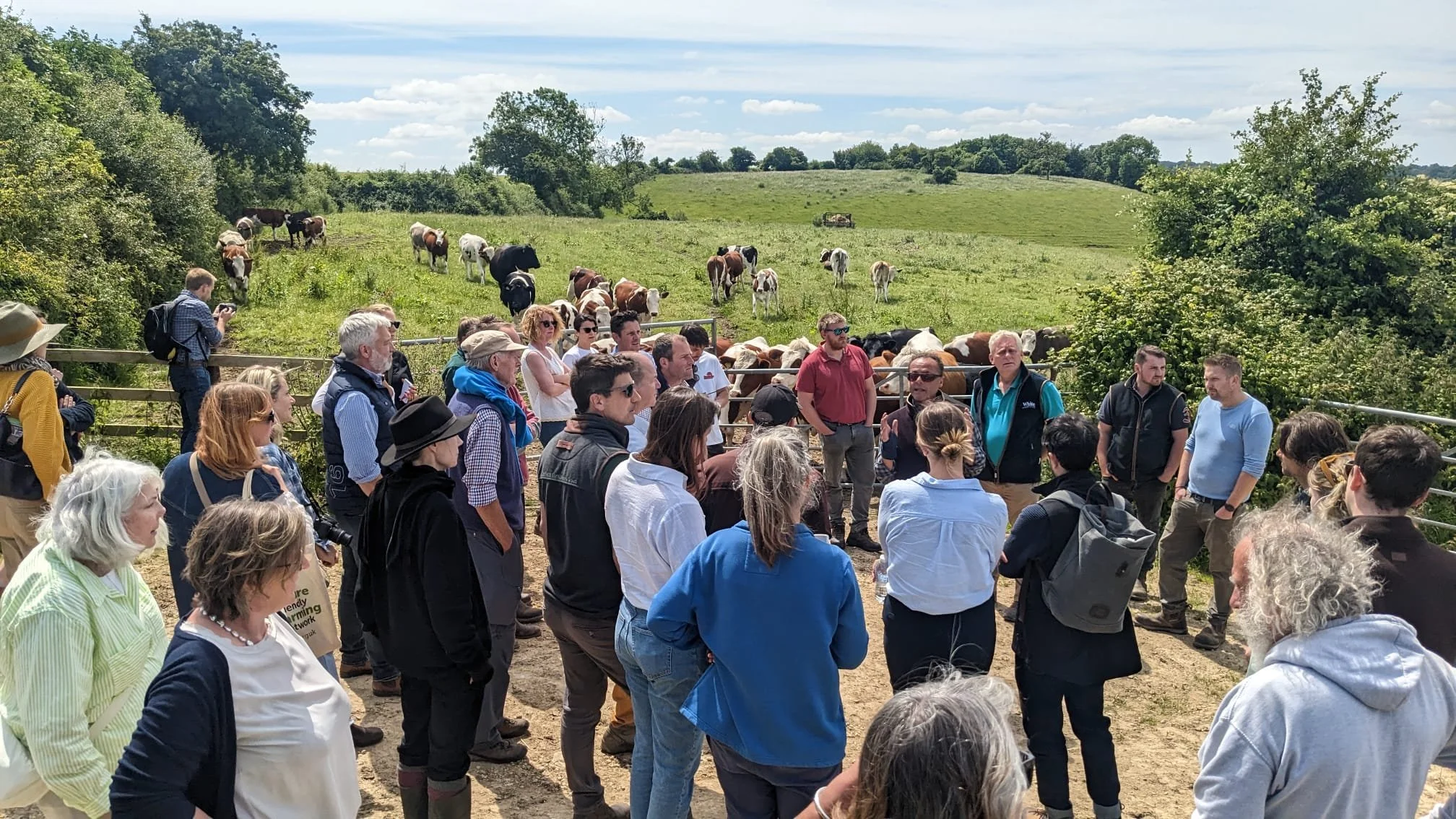
Virtual Roadshow 4: Scaling agroecology across Europe, in practice, research and policy
This enhanced ‘roadshow’ webinar brings together key policy experts, researchers and Innovation Hub leads to co-create a shared vision of our food and farming sector that is rooted in resilience and ecological integrity.
![Key Factors of Success and Failure in Dynamic Agroecological Systems [Scientific Paper]](https://images.squarespace-cdn.com/content/v1/6a2686979288c1416040814a/1780909728182-0QN85G43YRY3BPI933BE/res+paper+8-key+factors+of+succss+and+failure.jpg)
Key Factors of Success and Failure in Dynamic Agroecological Systems [Scientific Paper]
This report explores what helps or hinders the success of “Dynamic Agroecological Systems” (DynAEs) across Europe. These are farms, networks, and community initiatives putting agroecology into practice — using nature-based, socially inclusive, and economically fair approaches to food and farming.
![Citizen science can help expand farmland biodiversity monitoring efforts in support of agroecology [Practice Abstract]](https://images.squarespace-cdn.com/content/v1/6a2686979288c1416040814a/1780909728022-6OWH0SV4J0RV7T8XBANZ/pa+26-germany-citizen+science.jpg)
Citizen science can help expand farmland biodiversity monitoring efforts in support of agroecology [Practice Abstract]
Biodiversity monitoring in agricultural landscapes remains a major challenge for European policy implementation. Farmlands are spatially extensive and can be difficult to access, resulting in higher coordination costs and low participation in monitoring activities.
![Boosting Resilience at Biocoop Ștefan cel Mare through Agroecology and Smart Technology [Practice Abstract]](https://images.squarespace-cdn.com/content/v1/6a2686979288c1416040814a/1780909728008-L0WO5GQ05IBB8F2PW8JL/pa+25-romania-boosting+resilience+at+biocoop.jpg)
Boosting Resilience at Biocoop Ștefan cel Mare through Agroecology and Smart Technology [Practice Abstract]
The experience at Biocoop Ștefan cel Mare shows that the UN Food Systems Summit goals are achievable at the farm level today. By combining the "old wisdom" of biodiversity with ‘new tools’ of technology, farmers can build a business that is both environmentally regenerative and economically thriving.
![Learning faster together: a repeatable co-innovation approach for agroecological initiatives [Practice Abstract]](https://images.squarespace-cdn.com/content/v1/6a2686979288c1416040814a/1780909728189-8MKZJ2D1T2P89LDW7MOL/pa+24-netherlands-learning+faster+together.JPG)
Learning faster together: a repeatable co-innovation approach for agroecological initiatives [Practice Abstract]
Agroecological transformation is not simply achieved by implementing agricultural technologies. Initiatives (including farmer groups, advisors and other local actors) that want to innovate work in complex, changing conditions, need a practical way to learn, adjust and stay connected.
![Biological pest control – testing different type of soil covers to reduce slug damage [Practice Abstract]](https://images.squarespace-cdn.com/content/v1/6a2686979288c1416040814a/1780909727970-1IXQGHP23N6RDKK67Q7R/pa+23-slovenia-biological+pest+control.jpg)
Biological pest control – testing different type of soil covers to reduce slug damage [Practice Abstract]
The goal of this small experiment was to see how slug damage on lettuce could be reduced.
Two main approaches were chosen:
1. Different types of lettuce were planted ("normal" green lettuce, and red-leaved lettuce, both soft-leaved varieties).
2. Different types of soil cover were used in order to make access to the lettuce plants difficult for the slugs, and ideally impossible.
![Leipzig’s point system for leasing municipal farmland: transparent selection that rewards sustainable farming [Practice Abstract]](https://images.squarespace-cdn.com/content/v1/6a2686979288c1416040814a/1780909728195-26W80ZKAD0V1Z6ZPE05W/pa-22-germany-leipzigs-point-system.jpg)
Leipzig’s point system for leasing municipal farmland: transparent selection that rewards sustainable farming [Practice Abstract]
How can we incentivise the transition towards agroecology? Beyond the domain addressed by the Common Agricultural Policy (CAP), there are many other opportunities and actors who can take action.
![Where to add landscape features: a practical mapping and prioritisation approach [Practice Abstract]](https://images.squarespace-cdn.com/content/v1/6a2686979288c1416040814a/1780909728673-83WGWRI8ZVCIPOQUCO2X/pa+21-germany-where+to+add+landscape+features.JPG)
Where to add landscape features: a practical mapping and prioritisation approach [Practice Abstract]
The Nature Restoration Regulation requires restoring diverse landscape features in intensive agricultural areas, but how should this be done?
![Species selection for flowering inter-rows to vineyards and orchards [Practice Abstract]](https://images.squarespace-cdn.com/content/v1/6a2686979288c1416040814a/1780909728538-7FB2RCQQHVQZ3AS15P6H/pa-20-hungary-species-selection-for-flowering-inter-rows.jpg)
Species selection for flowering inter-rows to vineyards and orchards [Practice Abstract]
When applying flowering inter-row vegetation, one can choose from existing commercial mixtures or compose a mixture specifically designed for one’s site and needs. If so, selecting the right species is crucial.
![Makibio, a project embedded within a new respectful, participatory and transparent social contract between researchers and farmers [Practice Abstract]](https://images.squarespace-cdn.com/content/v1/6a2686979288c1416040814a/1780909728200-PP3T7GWOVMLWXJ30CKA9/pa+19-guadaloupe-makibio.jpg)
Makibio, a project embedded within a new respectful, participatory and transparent social contract between researchers and farmers [Practice Abstract]
Twenty-nine organic mixed crop–livestock farms in Guadeloupe were surveyed to characterise their multiperformance using the STREAM tool, developed by Agroecology-TRANSECT project. These farms were selected to reflect the diversity of agroecological crop–livestock integration practices across the archipelago. Given the length and density of the survey guide, the researchers proposed that the field phase be conducted using a participatory approach.
![Motivating farmers to implement eco-schemes that have highest impact on grasslands biodiversity conservation by explaining the effects of their nature friendly activities [Practice Abstract]](https://images.squarespace-cdn.com/content/v1/6a2686979288c1416040814a/1780909728218-QZZ2HQ0ZR2XNAOSIFJSB/pa+18-bulgaria-motivating+farmers+to+implement+eco-schemes.jpg)
Motivating farmers to implement eco-schemes that have highest impact on grasslands biodiversity conservation by explaining the effects of their nature friendly activities [Practice Abstract]
The lack of monitoring and evaluation of CAP support effects on biodiversity has been identified as a major barrier to effective governance of public funding and a source of demotivation for farmers.
![Selecting and testing the plant indicator species for developing result based agri-environmental payment schemes for high nature value grasslands in Bulgaria [Practice Abstract]](https://images.squarespace-cdn.com/content/v1/6a2686979288c1416040814a/1780909728513-EYLUVZ49WD7MQ06XWTCZ/pa+17-bulgaria-selecting+and+testing+the+plant+indicator+species.jpg)
Selecting and testing the plant indicator species for developing result based agri-environmental payment schemes for high nature value grasslands in Bulgaria [Practice Abstract]
In recent years, several EU countries have introduced result-based payment (RBP) schemes to enhance the environmental services provided by agriculture – promoting biodiversity, improving landscape quality, and supporting better water management.
Despite a growing number of initiatives, these schemes remain relatively rare in Europe and are often implemented only as pilots. RBP approaches are generally considered most suitable where they can support existing farming practices and traditional land-use systems, rather than in areas requiring substantial ecological restoration. For this reason, they are particularly relevant for High Nature Value (HNV) farming systems.
![Designing multi-species grassland mixtures to reduce fertiliser use and boost forage yield, resilience, and ecosystem services through strategic species selection [Practice Abstract]](https://images.squarespace-cdn.com/content/v1/6a2686979288c1416040814a/1780909728098-4U3V1MQDBLAAZVVZ9ZC5/pa+16-switzerland-designing+multi-species+grassland+mixtures.JPG)
Designing multi-species grassland mixtures to reduce fertiliser use and boost forage yield, resilience, and ecosystem services through strategic species selection [Practice Abstract]
Productive grasslands rely often on low plant diversity with high management intensity and fertiliser input. However, research shows that multi-species mixtures can deliver high forage yield and quality with lower inputs and environmental impact. Benefits include improved nutrient use efficiency, weed suppression, resilience to extreme weather, and enhanced soil fertility and biodiversity. The best example is the positive clover-grass combination that reduces the need for mineral nitrogen fertiliser through natural nitrogen fixation.
![A closer look at the plough pan: what is it exactly? Is ploughing the only cause? And what about the no-tillage pan? [Practice Abstract]](https://images.squarespace-cdn.com/content/v1/6a2686979288c1416040814a/1780909727809-IU24TKHRCJ0SP2GK71JQ/pa+15-belgium-a+closer+look+at+plough+pan.jpg)
A closer look at the plough pan: what is it exactly? Is ploughing the only cause? And what about the no-tillage pan? [Practice Abstract]
Ploughing is often criticized for its impact on soils, particularly for the risk of forming a ‘plough pan’, a compacted, repeatedly smoothed layer typically found at a depth of 25–30 cm.
![Research conducted in the West Indies suggests that local wildflower strips can contribute to melonworm control thought the natural recruitment of parasitoid wasps [Practice Abstract]](https://images.squarespace-cdn.com/content/v1/6a2686979288c1416040814a/1780909728440-EX6ZK8R2Z0BW38710ROP/pa+14-guadaloupe-research+conducted+in+the+west+indies.jpg)
Research conducted in the West Indies suggests that local wildflower strips can contribute to melonworm control thought the natural recruitment of parasitoid wasps [Practice Abstract]
The study conducted by researchers at INRAE Guadeloupe found that wildflower strips support the recruitment and maintenance of parasitoid wasps in the field. Moreover, wildflower strips provide a favorable environment for parasitoid communities, with a steady increase in the number of parasitoids sampled over time. Wildflower strip promote the recruitment of a high diversity of parasitoid wasps including many species associated with the regulation of the melonworm (Diaphania hyalinata), which is the main cucurbit pest in Guadeloupe due to the defoliation it causes.